HA7TM/PT7 - Fortaleza, Brazil - 2–18 February 2004
Toward the end of September 2003 I started thinking that the best way to avoid the winter cold would be to travel somewhere warm. Brazil became the choice, but being a radio amateur I naturally wanted to operate as well. I began working on the licence. In Hungary I first asked around and HA1SZ, Jóska, suggested that I contact PU2KER, Gyuri. Eventually I managed to reach him and asked what could be done. He promised to investigate. I sent copies of my amateur licence, passport and HAREC certificate. The first reaction was encouraging — then came the bad news.
I was told there was no amateur radio agreement between the two countries. I did not really understand why that should matter because I was asking for a Brazilian authorisation. After many letters back and forth, a solution was found: operating might be possible with a letter of sponsorship from a local radio club. At that point Sidnei, PT7VOI, became involved and provided the necessary sponsorship, which allowed me to obtain the HA7TM/PT7 callsign. He had one big request: he collected old radios and asked me to bring him a radio made in Hungary. I eventually found an ORION 222, kindly supplied by Pista, HA7XD.
On 2 February 2004 I packed the station: one IC-706, a 110/220 V PSU, one four-band DUNAX GP and all the small accessories — plus the Orion radio. At Budapest Airport the Customs officers could hardly stop laughing when they saw the old set. After a 15-hour flight we arrived in Fortaleza. Brazilian Customs went through everything thoroughly but let us continue without any real problem. PT7VOI and his wife were already waiting for us at the airport. They took us to the hotel and arranged for the antenna to be installed on the roof.
My first surprise was discovering that the supply was 220 V rather than 110 V. I switched the PSU to 220 V and turned it on. There was a loud bang, a short flash and a long trail of smoke — the power supply was dead. I spent the night wondering what would happen next after carrying all that radio equipment so far. The following morning I called PT7VOI. He reassured me that help would be found. Around noon reception called to say someone was looking for me. It was Elizio, PT7BZ. Twenty minutes later he arrived. I explained the problem, but he was already smiling because he had heard about it. He put the PSU under his arm, pushed me into his car and took me to his QTH, pointing out local amateur antennas along the way.
At his station he tuned up his rig and told me to operate while he looked at the power supply. I did not need asking twice. With 600 W and a 6-element Yagi, my first QSO on 21 MHz was with local station PT7VB. I moved to 18 MHz and the first Hungarian station calling was HA1DAE, followed by HA7UG, HA8UT, HA1TNX, HA0HV, HA5AGS and plenty of EU. My callsign started appearing on the DX Cluster every few minutes and I thoroughly enjoyed the EU pileup. Meanwhile Elizio returned with the PSU, shaking his head. It was not repairable there and appeared to have a manufacturing fault. I thought the operation was over before it had started, but he simply took an original Icom IC-706 power supply from the shelf, put it under his arm and drove me back to the hotel. The hospitality was outstanding.
The next morning I installed the Dunax GP on the roof of the fifth floor. The SWR was good immediately. I called CQ on 21 MHz and, when I went back to receive, I could hardly believe how many stations were calling. After about an hour there were already close to 200 QSOs in the log. I stayed up that night to find out what 40 m would be like. The pileup became so large that it was sometimes difficult to control. I could not really work split with the small IC-706, but at times the rate still reached 120–150 QSOs/hour. The mix was roughly one USA station for every EU station.
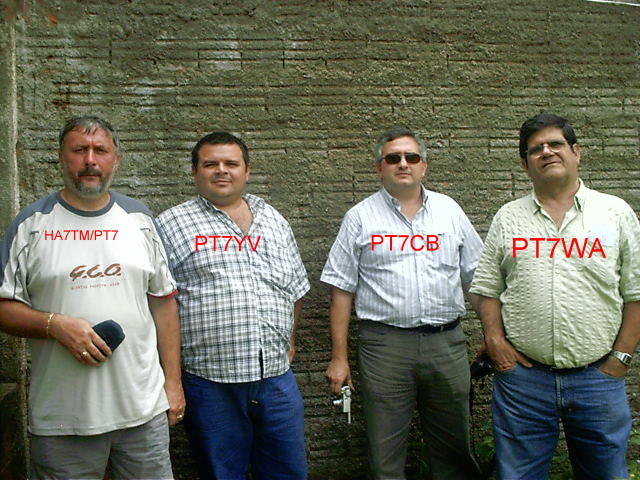
Of course we also went down to the sandy beach. In only three hours we managed to burn ourselves badly enough that dinner with PT7VOI and his wife had to be postponed. The next day Elizio arrived and took me to an amateur radio gathering. Five of us climbed into a 4×4 and drove to ZY7C, the Fortaleza contest QTH, followed by lunch and another QTH visit at PT7CB. There was plenty of friendly ham-radio conversation before we returned to the hotel.
That evening PT7VOI and his wife announced that there were no excuses: we were going to the Krokko bar to eat crab and enjoy the evening. We agreed, and it turned into a great night. The next day Roberto, PT7YV, appeared and took us out again. That pattern continued throughout the two weeks. It almost became embarrassing because they would not let us pay for anything, although food itself was inexpensive.
The failed PSU was sent to São Paulo for repair and returned after five days. Unfortunately it was still not right: once warm it reduced its output and put hum on my transmitted signal, so another PSU change was needed. I wondered what else could happen. We had already survived three days of stomach trouble, but Sidnei's wife was a nurse and quickly found medication that helped.
I had not brought an antenna specifically for 80 m, but the tuner could match almost anything. When I heard a 6W station calling CQ, I tuned the system and made the QSO. Later the band suddenly went quiet and the SWR went off scale. I suspected trouble. I called Géza, HA4XG, who immediately identified the likely fault: the static-discharge choke had failed. Cutting it out solved the problem and operation continued.
In the end I made close to 5,000 QSOs. I did not yet have the final breakdown because the log still had to be entered into the computer; the laptop had been left at home because our luggage was already overweight. On 16 February, after the daily QRX/sked with my son HA7JHM, I dismantled the station. Around noon Elizio came to collect the borrowed power supply and kept looking at the Dunax GP. In the end I left the antenna with him. Two weeks of events are difficult to compress into a few paragraphs; we also managed plenty of sightseeing. On the 17th we began another 15-hour journey and arrived home safely.
Many thanks to the Brazilian radio amateurs for all their help, and also to the Hungarian operators who followed the operation and worked me during the trip. There were far too many HA callsigns to list here.
73,
Tibi - HA7TM