
The story of installing the SteppIR MonstIR - 2007
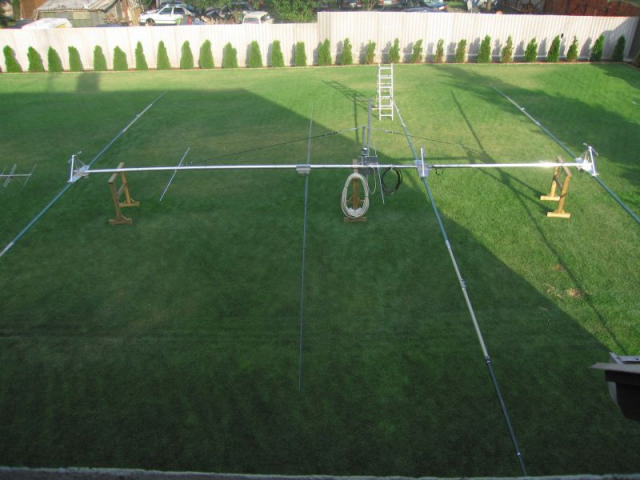
In December 2006 I decided to replace my antenna system with something better. Toward the end of the month I ordered the antenna through WiMo. I was told it should be ready by March because it was still being manufactured. It finally arrived at the end of April. Full of enthusiasm, I immediately started assembling it. It seemed quite complicated and I probably fitted almost everything twice. The American approach to assembly was very different from what I was used to, and the fasteners were not standard European sizes either.
Before the new antenna could go up, the old antennas had to come down from the tower: the 9-element Yagi, a 3-element monoband Yagi and the 13-element VHF Yagi. The wind was strong, but curiosity got the better of me and we pressed on. By about 4 p.m. we were ready to winch the MonstIR up, and the electric winch brought it as far as the work platform.
Unfortunately it caught on a VHF antenna mounted on the mast. We managed to turn it clear, but we did not notice that the rope had slipped sideways out of the pulley. On the next pull the pulley cut through the rope and the antenna fell from about 35 m. Every boom section was bent, one motor broke and three element sections were destroyed. I was extremely disappointed, but I decided not to give up. I wrote to SteppIR; they referred the matter back to WiMo.
WiMo ordered the replacement parts, which took about two months, but not the boom because they could manufacture that themselves. In the meantime I contacted an aluminium company in Kecskemét that produced the required AlMgSi 0.7 tubing for me at a very reasonable price. I was impatient to try again, so I rebuilt the antenna quickly, but this time I decided to be cautious and hired a 51 m crane. Unfortunately the second attempt also failed: as the crane started lifting the antenna, the boom folded because it could not support its own weight.
We dismantled the antenna again and waited for the boom from Germany. Even that was not straightforward, because the 65 × 5 mm tube would not fit inside the 70 × 3 mm tube. It was difficult to find a lathe capable of machining one millimetre from a full metre of tube. Eventually everything fitted and the antenna was assembled again. The 51 m crane returned, all foreseeable risks were eliminated, and this time the antenna was successfully lifted into position.
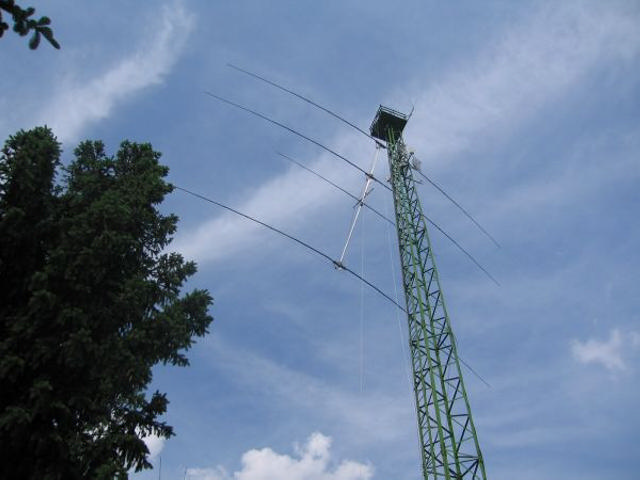
It was an impressive sight with an almost 11 m boom and 21.5 m elements. On 40 and 30 m it operates as a 3-element antenna; from 20 through 10 m it uses four elements; and on 6 m it can operate as a 6-element monoband Yagi. The first tests were sensational compared with the 4-element Quad. The difference was at least one S-unit, and in some cases 2–3 S-units. In my experience the antenna exceeded the published specifications. Several amateur friends listened to the comparisons and could hardly believe what they heard: HA5PT, HA7RY, HA5PP and HA5JI. For those of us used to traditional antennas, the technology seemed almost unreal. The principle itself had been known for a long time; K7IR succeeded in making it practical. TNX! (www.steppir.com)
The story continued. Because the antenna performed so well, I ordered another 4-element SteppIR covering 20 m and above. I installed it on a 21 m tower in place of the 4-element Quad. The improvement compared with the Quad was smaller at that location, but installation was quick and the antenna was in place within about an hour.
I was able to combine the two antennas. I tested the system during the 2007 LZ DX Contest and it worked extremely well. With the two antennas I could cover four directions. During the contest I hardly had to rotate them at all; stations were coming in from every direction.
On 17 May 2010 another disaster struck. Strong winds had been blowing for ten days, around 140 km/h. On the final day the support mast could no longer withstand the load and snapped. The wind turned the antenna roughly 180 degrees and pushed it over backwards. It fell from about 40 m into the neighbour's garden. Again several parts were damaged: one motor, the ends of three elements and the main support structure. I managed to replace the damaged parts and within a month the antenna was back in service. At the same time I converted the support structure to a lift system, so the antenna can now be raised and lowered, making future maintenance much easier.