My name is Tibor Németh, HA7TM.
I first learned the basics of amateur radio between 1971 and 1973 while attending industrial school, through the Budakalász Radio Club.
I passed my amateur radio examination in 1972 and received the callsign HA7TM in 1973. During the first years I took part in many ARDF and multi-discipline competitions. Gradually I moved toward HF operating, although at that time it was not easy to get on the bands. My first station consisted of a military R20 receiver and a home-built transmitter.
In 1974 we established the HA7KTM club station. I married in 1975; later my son, HA7JHM, and my daughter were born.
From 1975 until the end of the 1990s I concentrated mainly on contesting and, of course, DXing. During this period I helped train a number of HA and HG licence holders and contributed to bringing new operators into amateur radio.
I achieved several results worth mentioning. For many years I won Hungarian national championship titles and also achieved a number of international placings. In 1993 I received an award from the Ministry of Sport for outstanding international results.
As technology advanced, I became involved with increasingly sophisticated equipment. During the rapid growth of VHF FM packet radio we built the HA7TM BBS as a team, with two service stations: HG7PTM-2 and HG7PTM-7. Repeaters were one of the major developments of the 1990s. We successfully installed the HG7RVA and HG7RUA repeaters, which continue to operate under my supervision.
At the same time I also had to devote more attention to my business, a security monitoring service which, naturally, also had a strong radio communications component. It became the fifth-largest radio-based remote monitoring system in Hungary. Toward the end of the 1990s club activity became less prominent for me and I was mainly motivated by individual operating.
I built a 35 m antenna tower carrying a 9-element HF Yagi, the Mosley PRO-96. I used inverted-V dipoles on 160 and 80 m and a 13-element Yagi on 144 MHz. Later a 21 m tower carried a 4-element, 5-band Quad. In the neighbouring garden I had a Titanex V160HD GP. For receiving I used a K9AY, and on the roof I installed a 2 × 5-element Yagi array for 6 m. In 2007 I installed what I considered one of the wonders of modern antenna technology: a 4-element SteppIR MonstIR covering 7 to 50 MHz and behaving on each band like a monobander. Later I installed another SteppIR on the 21 m tower and was able to phase/switch the two antennas together.
Over the years my station equipment has included the Yaesu FTDX-9000D, FT-1000MP, Icom IC-706, IC-910H, FT-736 and the usual accessories.
In 2003 I received the callsign HG7T.
I also became active from a number of DX locations, including EA8/HA7TM, HA7TM/PT7, JY/HA7TM, 3B8/HA7TM and 5B/HA7TM. I visited A61AJ. I also had opportunities to operate or be around amateur radio in Kenya (5Z4), Tunisia (3V8BB), and Senegal as 6W/HA7TM, where I made 3,540 QSOs, which was a local record at the time. From the Canary Islands (EA8) I managed to operate from nearly all of the islands. In May 2004 I was invited to Banaba Island (T30C), but unfortunately my A61 commitments prevented the trip. In January 2006 I completed the HA7TM/HI9 operation from the Dominican Republic with about 8,000 QSOs.
In September 2004 I received DXCC, with SSB and CW Mixed credit. I currently have 337 confirmed DXCC entities.
My plans have always included continuing to operate from different parts of the world and, naturally, continuing to chase DX.
From 9 May 2006 I was again active from Senegal (6W). In Guinea-Bissau I received the callsign J5UTM and operated from there on two occasions, most recently in April 2007.
At the beginning of 2008 I started satellite operating using a 3D tracking system controlled by a Yaesu G-5500 and GS-232 interface.
From 9 May 2008 I was again on Tenerife (EA8).
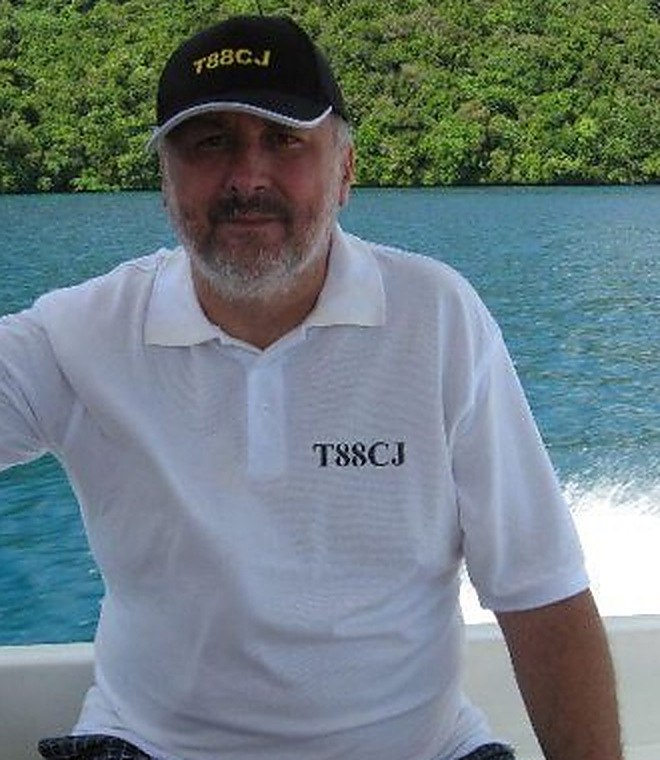
On 20 May 2008 I received the callsign T88CJ for Palau. More details can be found under DXpeditions and Photo Albums.
In March 2009 I received the news that, operating HG7T, I had achieved first place in the IARU HF World Championship.
On 20 March 2009 I received a Ministerial Certificate of Recognition for my outstanding sporting achievement in 2008.
2010 brought another major success with an IARU HF World Champion title.
On 1 April 2010 I purchased HA0DU's QTH at Debrecen-Haláp, a forest location far from man-made noise. I quickly began building the HG7T contest station there. Four new 35 m towers were installed with the following antennas: a 3-element Yagi for 40 m, 2 × 6-element Yagis for 20 m, a 6-element Yagi for 15 m and a 7-element Yagi for 10 m. An FTDX-5000MP also arrived. The first real test was CQ WW DX SSB, where I made about 4,600 QSOs. The QTH also performed very well in smaller contests. The construction of the station was documented continuously in the Photo Albums.
In both 2010 and 2011 I received the Hungarian title “Amateur Radio Sportsman of the Year”.
In 2013 the HG7T callsign was transferred to the Érd City Radio Club.
In 2015 I applied for and received the callsign HA7T for amateur radio contesting. Further information is available on QRZ.com.
In recognition of my amateur radio work and activities, on 6 December 2016 I received a Lifetime Achievement Award from the Hungarian Radio Amateur Society (MRASZ). Click the link above to watch the video.
73 & DX,
Tibi